
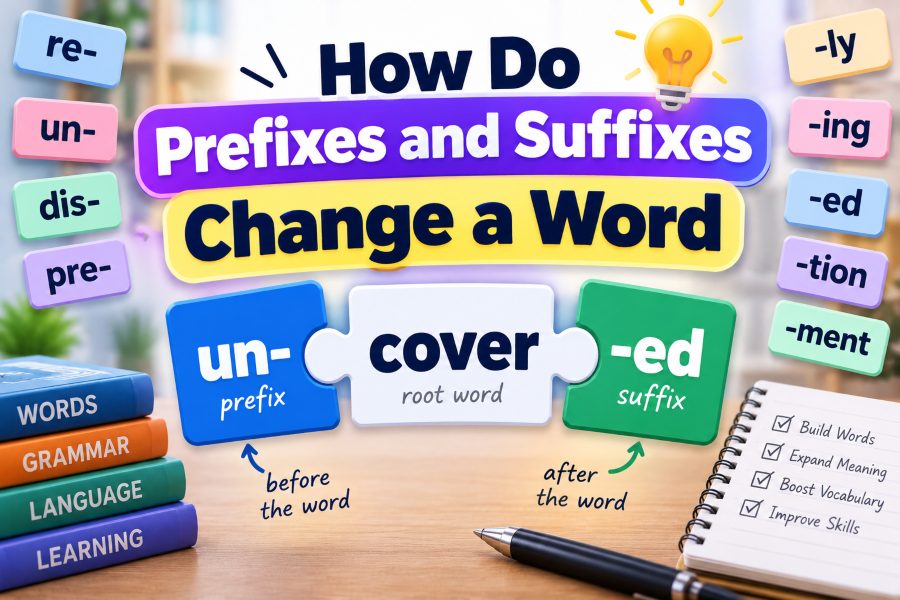
How do prefixes and suffixes change a word? They add meaning to a base word, often changing its definition, grammatical role, or tone. These small word parts help readers understand unfamiliar vocabulary.
A prefix appears at the beginning of a word, while a suffix is added at the end. For example, the prefix "un-" changes happy into unhappy, and the suffix "-ness" changes happy into happiness.
Understanding these patterns makes reading, spelling, and writing easier. Instead of memorizing every new term separately, learners can use known word parts as helpful clues.
Prefixes and suffixes are common in everyday English, academic language, and professional communication. Learning how they work builds a stronger and more flexible vocabulary.
A base word carries a word's central meaning. When an affix is attached to it, the new word still relates to that original idea but gains a more specific meaning.
Prefixes usually affect meaning without changing the word class. The prefix "re-" in rewrite means to write again, while "mis-" in misunderstand means to understand incorrectly.
Suffixes often change how a word functions in a sentence. Adding "-ly" to quick creates quickly, changing an adjective into an adverb.
Some suffixes make nouns, such as "-ment" in enjoyment or "-er" in teacher. Others make adjectives, including "-ful" in helpful and "-less" in fearless.
Context still matters because not every letter group is a true prefix or suffix. Recognizing common affixes, however, gives readers a reliable way to decode many words.
How Do Prefixes and Suffixes Affect Meaning?
Prefixes Can Reverse Meaning
Some prefixes create an opposite or negative meaning. For instance, "dis-" changes agree into disagree, and "in-" changes complete into incomplete. These additions tell the reader that the original condition, action, or idea has been denied or reversed.
Prefixes Can Show Time or Repetition
Prefixes can also explain when or how often something happens. The prefix "pre-" in preview means before viewing, while "re-" in reread means to read again. Such clues quickly reveal the relationship between the new word and its base.
Prefixes Can Indicate Position
Many prefixes describe place, direction, or relationship. In submarine, "sub-" means under, and in interconnect, "inter-" means between. These prefixes make a word more precise by adding spatial or relational information.
Suffixes Can Create Nouns
A suffix can turn a verb or adjective into a noun. The suffix "-tion" changes educate into education, while "-ity" changes active into activity. The resulting noun names a person, thing, quality, event, or concept.
Suffixes Can Create Adjectives
Suffixes such as "-ful," "-less," and "-able" commonly form adjectives. Care becomes careful, hope becomes hopeless, and read becomes readable. Each new adjective describes a quality connected to the base word.
Suffixes Can Change Verb Forms
Verb endings can show tense, progress, or completion. The suffix "-ed" often shows a completed action, as in walked, while "-ing" can show an ongoing action, as in walking. These endings help a sentence communicate time clearly.
Affixes Make Vocabulary More Precise
Adding a prefix or suffix can create a more exact word for a situation. Consider legal, illegal, legality, and legally. Each word shares the same root idea, but its affixes adjust the meaning and grammatical purpose.
Ways to Identify Prefixes and Suffixes
1. Look for a familiar base word inside a longer word, such as kind in unkindness.
2. Check whether the beginning of the word matches a common prefix like un-, re-, pre-, or mis-.
3. Check whether the ending matches a common suffix such as -ed, -ing, -ness, -ment, or -ly.
4. Remove the possible affix and decide whether the remaining base word has a clear meaning.
5. Use the surrounding sentence to confirm whether the meaning suggested by the affix makes sense.
Common Affixes That Build Stronger Vocabulary
- Un-: This prefix often means not or the opposite of, as in unfair and unknown.
- Re-: This prefix usually means again, as in replay, rebuild, and reconsider.
- Pre-: This prefix means before, as shown in preheat, preschool, and predict.
- -ness: This suffix turns many adjectives into nouns that name a state or quality, such as kindness.
- -ment: This suffix often forms nouns from verbs, including development and achievement.
- -ful: This suffix forms adjectives that mean full of a quality, such as joyful and useful.
- -less: This suffix forms adjectives that mean without something, as in careless and powerless.
Why Affixes Matter in Reading and Writing
They Help Readers Decode New Words
Readers often meet unfamiliar words in books, articles, and instructions. Knowing that "anti-" means against or that "-ology" relates to the study of something can provide an immediate meaning clue before a dictionary is needed.
They Improve Spelling Awareness
Affixes reveal useful spelling patterns. When adding a suffix, writers may need to drop a final e, double a consonant, or change y to i. Understanding these patterns supports more accurate spelling in everyday writing.
They Support Better Word Choice
Affixes let writers select words with the right level of detail. Rather than saying "not organized," a writer may choose disorganized. This creates clearer, more concise sentences while preserving the intended meaning.
They Clarify Grammar in Sentences
Suffixes often signal a word's grammatical job. The ending "-er" may identify a person who performs an action, while "-ly" often identifies an adverb. These signals help writers construct sentences that flow correctly.
They Strengthen Academic Language
Academic vocabulary frequently uses Greek and Latin affixes. Words such as renewable, interpretation, and multinational become easier to analyze when learners recognize the meaningful parts that form them.
They Make Word Families Easier to Learn
A word family groups related forms around one root, such as decide, decision, decisive, and indecisive. Learning the family together shows how a root can work in different parts of speech and contexts.
They Encourage Independent Learning
Students who understand affixes do not need to rely solely on memorization. They can break down an unfamiliar word, test a likely meaning, and use context to refine their interpretation. This creates confidence and stronger reading independence.
Prefixes and suffixes change a word by adding meaning and, in many cases, changing how it works in a sentence. A prefix comes first, while a suffix comes last.
These word parts can express contrast, repetition, time, position, quality, action, and much more. They also connect related words within the same word family.
The best way to build this skill is to notice affixes while reading and practice separating them from base words. Over time, common patterns become easy to recognize.
When learners understand how do prefixes and suffixes change a word, they gain a practical tool for vocabulary growth, clearer writing, and more confident reading.
FAQs About how do prefixes and suffixes change a word
What is the difference between a prefix and a suffix?
A prefix is added to the beginning of a base word, while a suffix is added to the end. Both can change meaning, but suffixes are more likely to change a word's grammatical role.
Can a prefix change a word into its opposite?
Yes, many prefixes can create an opposite or negative meaning. For example, happy becomes unhappy, and possible becomes impossible.
Do suffixes always change the part of speech?
No, but many do. For example, -ness changes kind from an adjective into kindness, a noun, while -ed can simply show that a verb happened in the past.
What is a base word?
A base word is the meaningful core of a word before prefixes or suffixes are added. In replaying, play is the base word, re- is the prefix, and -ing is the suffix.
How can I learn common prefixes and suffixes?
Start with frequently used affixes such as un-, re-, pre-, -ly, -ness, and -ment. Read words containing them, identify the base word, and compare the new meaning with the original meaning.
Can one word have both a prefix and a suffix?
Yes, many words contain both. In unhappiness, un- is the prefix, happy is the base word, and -ness is the suffix.