
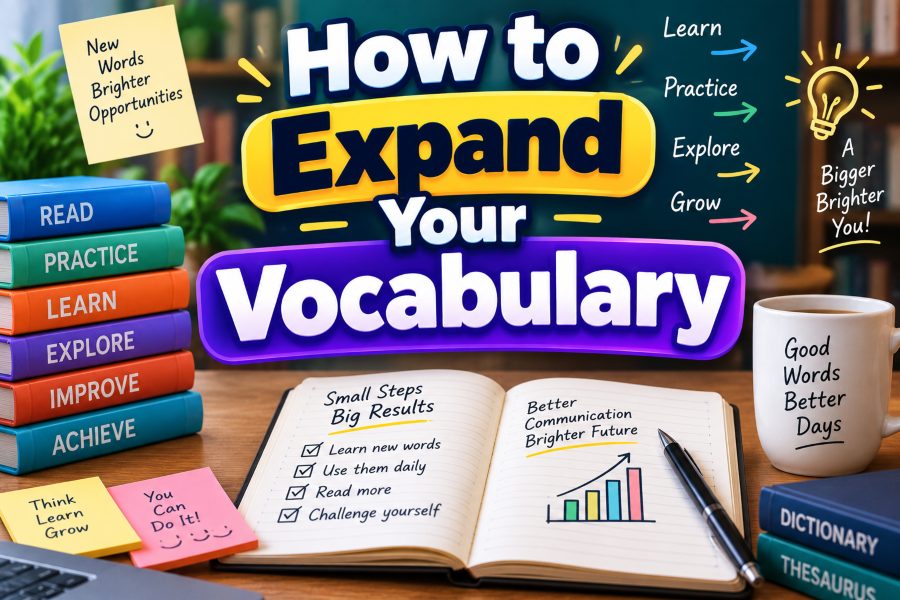
Learning how to expand vocabulary naturally begins with regular exposure to meaningful language. Instead of memorizing disconnected word lists, notice useful words while reading, listening, writing, and talking. Context helps you understand not only a definition but also the tone, purpose, and situations where a word fits.
A larger vocabulary can make everyday communication clearer and more confident. It supports stronger essays, more precise work emails, better conversations, and deeper understanding of books, news, and professional material.
The goal is not to use complicated words whenever possible. A practical vocabulary gives you choices, allowing you to select the clearest, most accurate word for each idea.
With small daily habits and repeated practice, anyone can build vocabulary steadily. The most effective approach combines curiosity, active recall, and real-world use.
Vocabulary growth works best when it is connected to interests. A reader who enjoys history, sports, business, or fiction will remember new language more easily when it appears in topics they already care about.
Reading slightly above your current comfort level is especially useful. Choose material that challenges you without making every sentence difficult, and focus on a few valuable unfamiliar words rather than stopping for every one.
Keep a simple word record in a notebook or notes app. Include the word, a short definition in your own language, one example from the source, and a sentence you create yourself.
Repetition turns recognition into usable knowledge. Review new words over several days, then look for opportunities to hear, read, or use them again in different contexts.
Be patient with the process. Knowing a word usually develops in stages: first you recognize it, then you understand it, and eventually you can use it accurately without stopping to think.
How Can You Build Vocabulary Every Day?
Read With a Purpose
Set aside time for books, articles, newsletters, or essays that suit your interests. When you encounter an unfamiliar word, first infer its meaning from nearby sentences before checking a reliable dictionary.
Learn Words in Phrases
Study common word partners rather than isolated definitions. For example, learning that people “make a decision” or “raise a concern” helps you use new vocabulary in natural, fluent combinations.
Use a Dictionary Strategically
A good learner's dictionary can show pronunciation, grammar, usage notes, synonyms, and example sentences. Check only words that seem useful, repeated, or important to the main idea.
Create Personal Examples
Write a sentence that connects each new word to your life, work, studies, or opinions. Personal examples are easier to remember because they give the word a specific mental link.
Practice Active Recall
Cover the definition and try to explain the word from memory, or see the definition and recall the word. This effortful practice strengthens memory more effectively than simply rereading a list.
Speak New Words Aloud
Use new vocabulary in low-pressure conversations, voice notes, or speaking practice. Saying a word aloud improves recall and helps you become comfortable with its pronunciation and rhythm.
Review at Spaced Intervals
Return to new words after one day, several days, and a few weeks. Spaced review prevents quick forgetting and gives you repeated chances to notice whether you can use each word correctly.
Five Habits That Make New Words Stick
1. Choose a small daily target, such as three useful words, so your learning remains consistent and manageable.
2. Connect each new word to a synonym, an antonym, or a familiar situation to create stronger memory cues.
3. Rewrite a sentence from something you read by replacing a vague word with a more precise alternative.
4. Test yourself before reviewing your notes, because trying to remember a word reveals what needs more practice.
5. Use new vocabulary within twenty-four hours in a message, journal entry, conversation, or short piece of writing.
Useful Tools for Faster Word Learning
- Learner's dictionary:: Use one that includes pronunciation, example sentences, word forms, and common usage patterns.
- Flashcard app:: Create cards with a word on one side and a personal example or simple meaning on the other.
- Vocabulary notebook:: Group words by topic, such as travel, work, emotions, or academic writing, for easier review.
- Audiobooks and podcasts:: Listen to natural pronunciation and notice how speakers choose words in real contexts.
- Reading highlights:: Save useful passages so you can revisit words with the original context that made them memorable.
- Thesaurus:: Use it to compare related words, but always check a dictionary before assuming two words are interchangeable.
- Writing checker:: Review suggestions carefully to discover clearer alternatives and learn why a particular word may fit better.
Turn a Bigger Vocabulary Into Better Communication
Prioritize Precision Over Complexity
The best word is the one that communicates your meaning accurately for the audience and situation. Clear language is more valuable than impressive language that sounds forced, vague, or overly formal.
Adapt to Your Audience
A technical term may be appropriate in a specialist report but confusing in a customer email. Consider what your listener or reader already knows before choosing advanced vocabulary.
Strengthen Your Writing
During revision, replace repeated general words with specific alternatives when doing so improves meaning. For instance, describing an idea as “practical,” “ambitious,” or “controversial” says more than calling it simply “good.”
Improve Professional Conversations
Build vocabulary related to your field, including action verbs and terms used in meetings. Knowing language such as “clarify,” “recommend,” “evaluate,” and “prioritize” helps you contribute with greater confidence.
Understand Nuance and Tone
Words with similar dictionary meanings can carry different emotional effects. Learning distinctions between words such as “assertive,” “confident,” and “aggressive” helps you communicate with better judgment.
Avoid Overusing New Terms
New words should feel natural within a sentence. If you are unsure about usage, keep the sentence simple, check examples, and wait until you have seen the word used repeatedly.
Measure Real Progress
Track whether you can recognize, explain, pronounce, and use a word correctly without notes. This practical standard is more useful than counting how many words you have copied into a list.
Knowing how to expand vocabulary is less about cramming and more about building a steady relationship with language. Read attentively, collect useful words, and return to them often.
Focus on words you are likely to use in your studies, career, interests, and conversations. When vocabulary has a real purpose, it becomes easier to remember and more rewarding to practice.
Use each new word in context as soon as possible. A short sentence, a conversation, or a journal entry can move a word from passive recognition to active knowledge.
Progress will accumulate through consistency. A few well-learned words each day can create a noticeably stronger and more flexible vocabulary over time.
FAQs About how to expand vocabulary
How many new words should I learn each day?
Aim for three to ten useful words per day, depending on your available time. Learning fewer words thoroughly is more effective than memorizing many words you cannot later recognize or use.
Is reading the best way to expand vocabulary?
Reading is one of the most effective methods because it shows words in context, but it works best alongside review, writing, listening, and speaking practice.
Should I memorize dictionary definitions?
A short definition can help, but personal examples and real contexts are usually easier to remember. Learn how a word behaves in a sentence, not only what it means in isolation.
How can I remember words I keep forgetting?
Use spaced repetition and active recall. Revisit the word at increasing intervals, test yourself before looking at the answer, and create several meaningful sentences with it.
Are flashcards useful for vocabulary learning?
Yes, especially when cards include a sentence, image, synonym, or personal connection. Flashcards are most effective when you review them regularly instead of only making them once.
How do I use advanced words without sounding unnatural?
Choose advanced vocabulary only when it improves precision or clarity. Read and listen to reliable examples, then use the word in simple sentences until its natural tone and context become familiar.